Blackberry
Blackberries are a rewarding fruit for temperate gardeners—they're hardy, productive, and thrive in zones 5-8 with minimal fuss. The main challenge most growers face is managing their vigorous, thorny canes and keeping them from taking over the garden. With proper pruning and support, one mature plant can yield several kilograms of fruit annually.
Watering Blackberries
Water deeply once per week during the growing season (May to September), aiming for 5-7 cm of moisture weekly during fruiting and hot spells. Reduce watering in autumn and winter when plants are dormant—only water during dry periods. In spring, increase frequency as new canes emerge. Mulch around the base with 5-8 cm of compost or straw to retain moisture and suppress weeds.
Light Requirements
Blackberries demand full sun—at least 6-8 hours of direct light daily—to produce sweet, abundant fruit. In partial shade, canes grow tall and leggy with fewer flowers and berries. Avoid planting on north-facing walls or under tree canopy. Position canes on trellises or fence supports to maximize air circulation and light exposure to all growth.
Soil & Repotting
Blackberries prefer well-draining, slightly acidic soil (pH 5.5–7.0) rich in organic matter. Before planting, amend heavy clay with compost and sand to prevent waterlogging, which causes root rot. Plant in early spring (March–April) or autumn (October–November) in temperate zones. No repotting is needed—these are perennial ground plants; instead, manage soil fertility with annual mulch and compost applications.
Temperature & Humidity
Blackberries are very hardy and thrive in zones 5-8, tolerating winter temperatures down to -15°C when dormant. They have no special humidity needs and actually prefer lower humidity to prevent fungal disease. In late autumn (November), canes naturally go dormant and drop leaves—this is normal. Protect new canes from late spring frosts by delaying pruning until May.
Fertilizing Blackberries
Apply balanced fertilizer (10-10-10) in early spring as new growth emerges, then switch to a higher-potassium formula (e.g., 5-10-15) in June to promote flowering and fruiting. Avoid high-nitrogen feeds, which produce excessive leafy growth at the expense of berries. A spring mulch of compost also adds slow-release nutrients; mature plants rarely need additional feeding if soil is rich.
Common Problems & Solutions
Rust and leaf spot appear in wet summers—remove infected canes and improve air circulation. Cane borer and raspberry beetle larvae tunnel into canes and fruit; prune out damaged canes below the injury and remove affected berries. Blackberry mites cause yellowing and stunting; spray with sulfur in early spring before leaves fully emerge. Mow or dig out runners if the plant spreads beyond its boundary.
Frequently asked questions
How often should I water blackberries?
Water deeply once weekly during the growing season (May–September), providing 5-7 cm of moisture each week during fruiting and dry spells. Reduce frequency in autumn and winter when the plant is dormant, watering only if there is no rain for 2-3 weeks.
When do blackberries fruit and how do I harvest them?
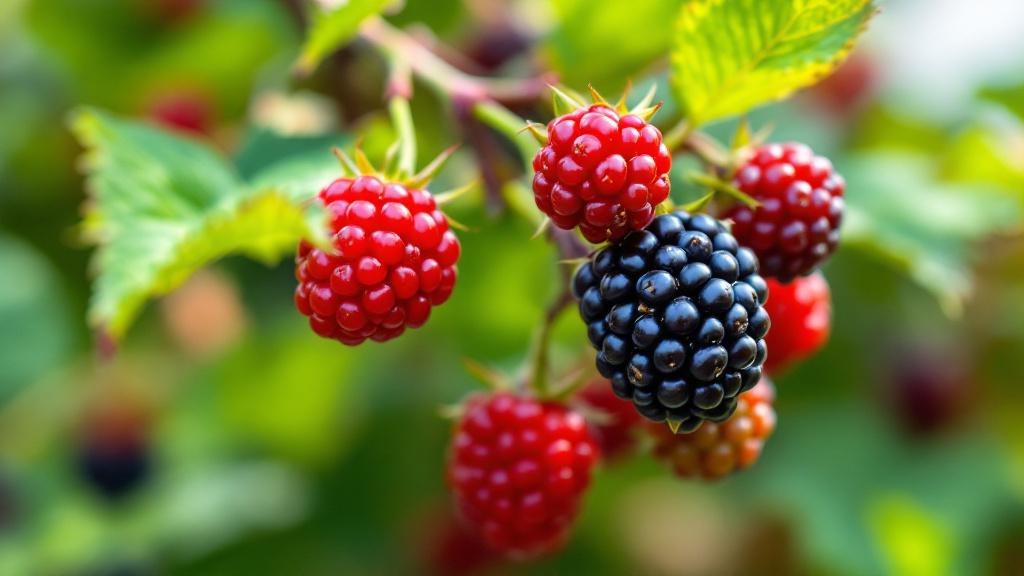
Blackberries typically fruit from June to August in temperate zones, with peak harvest in July. Pick berries when fully black and slightly soft to the touch—they do not ripen further once picked. Harvest every 2-3 days during peak season to encourage continued flowering and prevent overripe fruit from attracting pests.
How do I prune blackberries correctly?
Prune immediately after harvest (August–September) by cutting fruited canes to the ground—these two-year-old canes will not fruit again. Thin new first-year canes to 4-6 of the strongest per plant, and tie them horizontally to a trellis to encourage side shoots. In late winter (February–March), cut side shoots back to 30-45 cm to promote compact fruiting branches.
Why are my blackberry leaves turning yellow or spotted?
Yellowing often signals rust or leaf spot disease, common in wet, humid summers in the UK and Central Europe. Improve air circulation by pruning out crowded canes, remove affected foliage, and avoid overhead watering. Spray with sulfur or copper fungicide in early spring as a preventative before leaves fully emerge.
Do blackberries need a support structure?
Yes, supporting canes on a trellis or fence is essential—it improves light exposure, reduces disease, makes harvesting easier, and keeps thorny growth contained. Train canes horizontally or in a fan pattern, tying them loosely with soft twine to prevent damage as new growth hardens.